
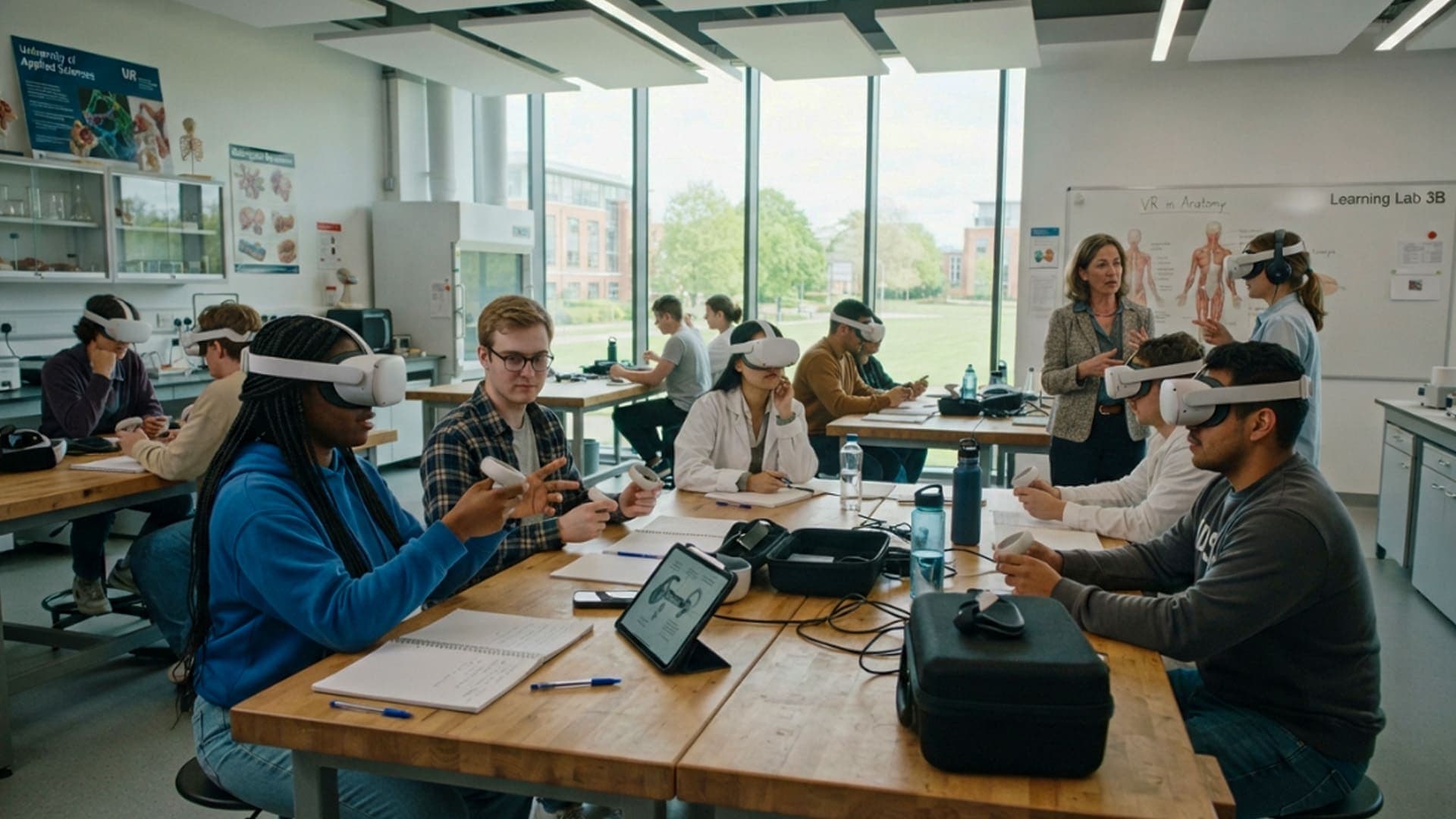
Virtual Reality in Higher Education: Turning Theory Into Practical Learning
Virtual reality is giving universities new ways to support practical learning, realistic simulations and deeper understanding when students need more than lectures, slides and textbooks.
Virtual Reality in Higher Education: Turning Theory Into Practical Learning
Higher education is built on knowledge, discussion, research and critical thinking. Lectures, textbooks, laboratories and group work all play an important role in helping students understand their subject. However, many topics become easier to grasp when students can see a concept in context, practise a skill repeatedly or experience a realistic situation before they enter a real workplace.
Virtual reality gives universities another way to support this type of learning. A headset can place a student inside a simulated environment where they can explore, observe, make decisions and practise without needing to travel to a location or use expensive equipment for every activity.
The value of VR is not that it replaces lecturers, laboratories or real-world placements. It can strengthen these parts of education by giving students additional preparation and practice. A medical student can rehearse a procedure before entering a clinical environment. An engineering student can inspect a complex structure from every angle. A history student can explore a reconstructed site and connect information to a physical setting.
In 2026, universities are becoming more focused on using immersive learning where it has a clear academic purpose. The strongest experiences are short, connected to a learning outcome and supported by discussion, assessment or practical work outside the headset.
Why Some University Subjects Need More Than a Lecture
Lectures are valuable for introducing ideas, explaining theory and helping students understand the wider context of a subject. However, some concepts are difficult to communicate through slides alone. Students may need to understand scale, movement, spatial relationships, risk or the consequences of a decision.
A diagram can show the parts of a machine, but it may not show how those parts work together in a real environment. A textbook can describe a historical building, but it cannot always communicate how the space feels or how people moved through it. A training video can explain a safety process, but it may not give students a chance to identify hazards for themselves.
VR can help make these ideas more concrete. Students can move through a virtual environment, inspect objects closely and respond to scenarios as they unfold. This gives educators another way to connect abstract knowledge to practical understanding.
Learning Through Experience and Reflection
An immersive activity is most useful when it is followed by reflection. Students should not simply enter a virtual environment, complete an activity and move on. They need an opportunity to discuss what they noticed, explain their choices and connect the experience back to the academic content.
For example, a student using a virtual laboratory may need to explain why they selected a particular method. A student exploring a built environment may need to identify design decisions and discuss their impact. A healthcare learner may need to reflect on communication choices made during a simulated scenario.
This process helps turn the VR experience into learning rather than entertainment. The headset provides the context, while the lecturer helps students interpret what happened and understand why it matters.
Giving Students a Safer Place to Practise
Many university programmes include practical skills that cannot be learned through reading alone. At the same time, real-world practice can be limited by cost, safety requirements, available equipment and the number of students who need access.
VR can give students a controlled place to begin. They can repeat a process, make mistakes and learn from feedback without creating risk or damaging equipment. This can be useful before a laboratory session, placement, field trip or workshop activity.
The virtual environment does not need to copy every detail of the real world. It needs to support the specific skill or decision students are expected to develop. A focused simulation is often more useful than a large virtual world with too many unrelated features.

Virtual Reality Across Different University Subjects
VR can support a wide range of academic disciplines because many subjects involve places, processes or situations that are difficult to access regularly. The way it is used should depend on the learning goal rather than the subject name alone.
In science and engineering, VR can help students visualise complex systems, practise procedures and explore environments that may be unsafe or expensive to recreate. In health programmes, it can support scenario-based practice where students need to make decisions under pressure. In humanities subjects, it can provide context for history, culture, architecture and geography.
The most effective use happens when lecturers identify a specific point in a course where students commonly struggle. VR can then be designed as a targeted activity that gives them another way to understand the topic.
Science, Engineering and Technical Learning
Students in technical fields often need to understand objects and systems in three dimensions. A VR model can allow them to walk around a structure, examine components and view a process from perspectives that would be difficult to achieve in a standard classroom.
An engineering student may inspect the inside of a turbine, explore a construction site before a visit or practise identifying safety risks. A science student may move through a molecular structure, observe a process at a different scale or prepare for a laboratory procedure.
This can help students arrive at practical sessions with more confidence. Instead of encountering equipment or environments for the first time under pressure, they have already had an opportunity to become familiar with the basics.
Healthcare and Professional Practice
Healthcare education requires students to combine knowledge with communication, observation and decision-making. Simulations can help learners practise these skills before they work with real patients or enter demanding environments.
A VR scenario can place a student in a clinical setting where they need to identify information, respond to a situation and make choices within a structured process. The experience can be repeated, allowing students to improve their approach after feedback.
This should always be used alongside qualified teaching and real-world practical learning. VR can prepare students for practice, but it cannot replace the judgement, supervision and human interaction required in professional settings.

Making VR Part of the Course Rather Than a Once-Off Activity
A VR experience has more value when it fits naturally into a module. If students use a headset once without preparation or follow-up, they may remember the technology more clearly than the academic lesson.
Lecturers can improve the value of VR by introducing the topic before the activity, giving students a clear task to complete inside the simulation and discussing the results afterwards. This creates a structured learning sequence rather than an isolated demonstration.
The activity should also be connected to assessment where appropriate. Students may write a reflection, complete a short quiz, analyse a scenario or apply what they learned in a practical session. This helps them understand that the immersive experience is part of the course, not an optional extra.
Keep Experiences Focused and Manageable
Long VR sessions are not always necessary. In many cases, a short activity of five to fifteen minutes can be enough to demonstrate a concept, introduce a scenario or allow students to practise a key decision.
Shorter sessions are easier to manage in a university timetable. They allow more students to use available headsets, reduce fatigue and make it easier for lecturers to build the activity into a normal class period.
A focused experience should have a clear beginning, purpose and end. Students need to know what they are expected to notice, what they should do and how the activity connects to the wider lesson.
Support Lecturers and Technical Staff
Successful VR programmes need more than headsets. Lecturers need time to understand the content, decide how it fits into their teaching and prepare students for the experience. Technical staff need clear processes for device setup, charging, cleaning, updates and troubleshooting.
Universities can begin by supporting a small group of lecturers who are interested in testing immersive learning in a specific module. Their feedback can help the institution understand what training, equipment and content support are needed before expanding further.
This approach is more sustainable than purchasing equipment without a clear plan for use. The technology should serve the teaching strategy, not force educators to change their course around a device.

Accessibility, Comfort and Student Choice
VR should make learning more accessible, not create new barriers. Some students may not be comfortable wearing a headset, may experience motion discomfort or may need an alternative way to access the learning activity.
A university should provide other ways to achieve the same learning outcome. This may include a desktop version of the simulation, a guided video, a 360-degree experience on a screen or a lecturer-led demonstration. Students should not be disadvantaged because a particular format does not work for them.
Comfort also matters. Experiences should avoid unnecessary movement, provide clear pause options and allow students to stop easily. Seating can be useful for activities that do not require walking, while standing experiences need enough space and supervision.
Protecting Student Data
Immersive learning systems can collect information about performance, movement, choices and time spent inside an activity. Some of this information can help lecturers understand where students need support, but it must be handled carefully.
Universities should be transparent about what data is collected, why it is collected and who can access it. Students should understand whether their activity is being assessed and how their information will be stored.
Data collection should remain proportionate to the learning purpose. The ability to collect detailed information does not mean every detail needs to be recorded. Clear governance helps institutions use immersive technology responsibly while protecting student privacy.
Starting With a Practical Pilot
A university does not need to introduce VR across every faculty at once. A pilot programme can focus on one module, one practical skill or one learning challenge where immersive technology may offer a clear benefit.
The pilot should include feedback from students, lecturers and technical staff. The university can review whether students understood the activity, whether the equipment was reliable and whether the experience improved engagement or practical confidence.
This makes it easier to improve the programme before it expands. It also helps institutions decide whether they need more content, more devices, additional staff training or better access arrangements.

Preparing Students for Real-World Learning
Virtual reality is becoming more useful in higher education because it can give students a place to explore, practise and prepare before they face real-world situations. It can make complex concepts easier to see, create safer opportunities for repetition and help lecturers bring practical context into the classroom.
The most valuable VR experiences are not designed to impress students with technology. They are designed to help students understand a topic, build a skill or make a better decision. When immersive learning is connected to clear teaching goals, supported by educators and made accessible to different learners, it can become a practical part of university education.
Author: Elisha Roodt
Exploring the frontiers of immersive technology, delivering expert insights into VR, AR, and the digital future of South Africa.